
Key highlights
- Whitespark guards profiles and builds citations, Semrush Local automates posts and review replies
- Whitespark's Local Platform is about $1 per location, Semrush Local starts at $30
- Whitespark citation building is a one-time cost, Semrush listing sync is an ongoing subscription
- In Semrush Local, removing a client doesn't automatically lower your paid location limit
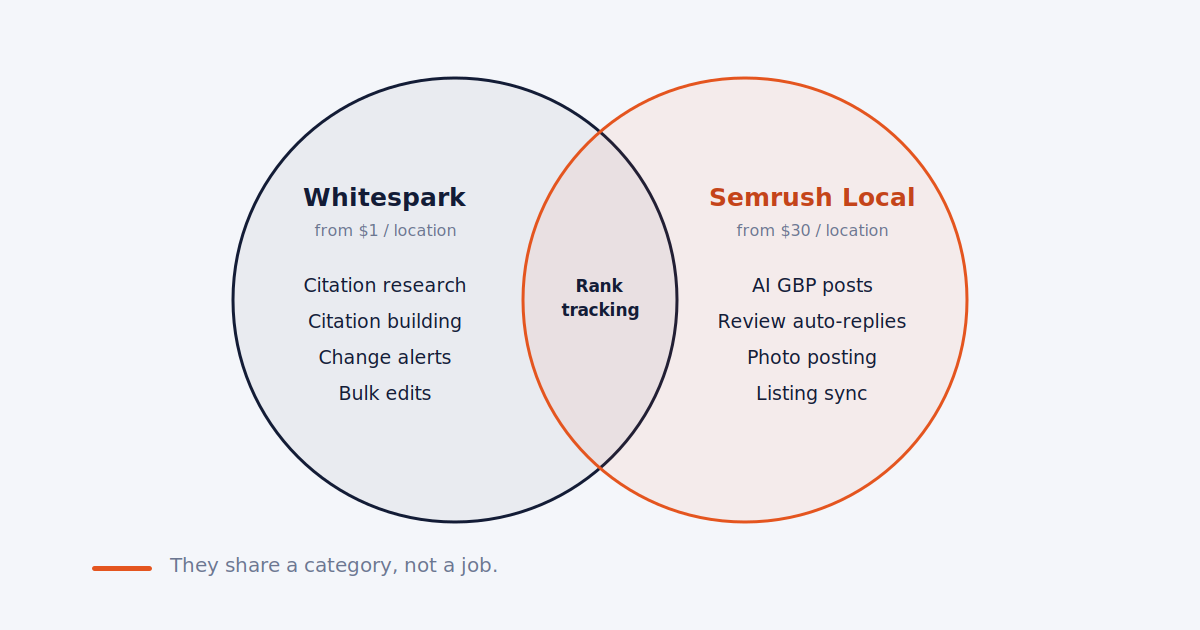
Whitespark and Semrush Local show up on the same shortlists because they share a category name. Look at what each one actually does, though, and they overlap far less than you'd expect.
Whitespark is mostly about guarding profiles, building citations, and tracking rankings. Semrush Local is mostly about automating the content side of a Google Business Profile: posts, photos, and review replies.
So the useful question isn't which one is better. It's which job you're trying to hand off.
The short answer
| Whitespark | Semrush Local | |
|---|---|---|
| Main job | Citations, rank tracking, guarding profiles | Posting, review replies, listing sync |
| Profile management | $1 per location: alerts, bulk edits, change history | $30 per location: AI posts, review auto-replies, photo posting |
| Citations | Research tool plus one-time building service | Ongoing listing sync on Pro, $60 per location |
| Rank tracking | Priced by keyword volume, unlimited locations | Credits included with each plan |
| How you buy it | Separate products, pick what you need | One product, two self-serve tiers |
If your clients pay you to keep their profiles active, Semrush Local. If they pay you for citations, rankings, and accurate listings, Whitespark. The rest of this is detail on that.
Job one: getting listed in directories
Whitespark is known for this. Its Local Citation Finder (roughly $33 to $149 a month) shows where competitors are listed and where your client is missing. The building itself is sold as a one-time service. You pay for the project, and the listings it creates are ordinary directory listings the business keeps.
Semrush Local handles directories on its Pro tier at $60 per location. It pushes the business's details out to directories and keeps them in sync while you're subscribed. Semrush's own help docs say that if you cancel, the listings stay in the directories but stop being managed, so they fall back to each directory's normal updates.
The difference is a project versus a service. For a client whose name, address, and phone number just need cleaning up once, a project fits. For a business that changes hours or opens locations often, ongoing sync earns its cost.
Job two: keeping the profile active
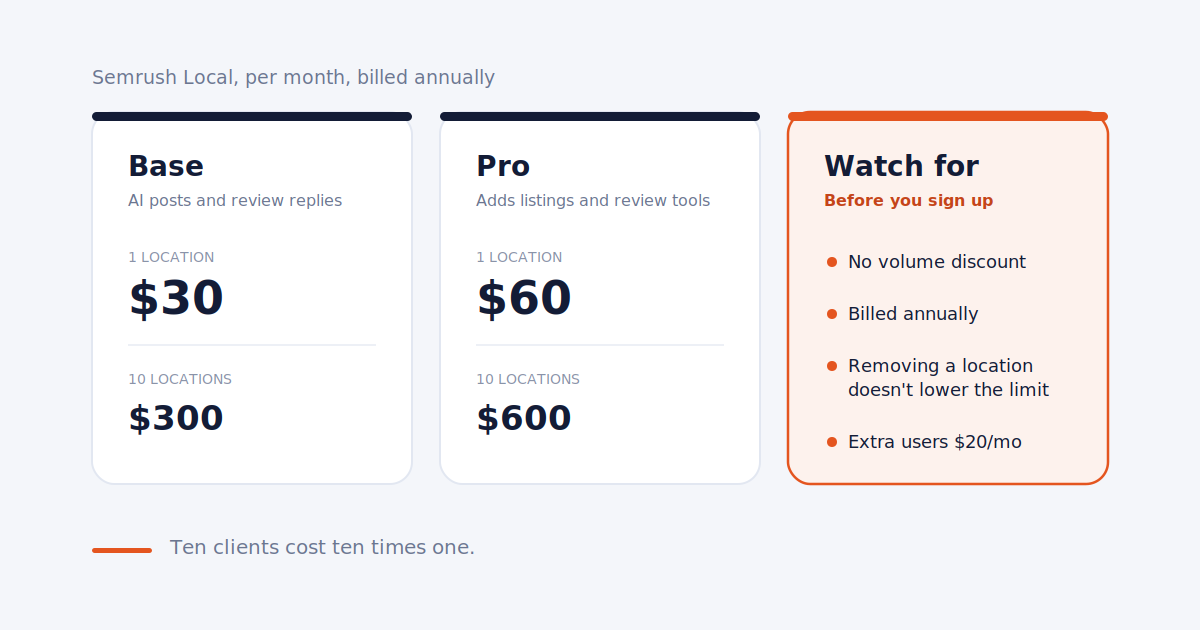
This is where Semrush Local is strongest. The Base tier, $30 per location, includes AI-generated GBP posts that publish for you, automatic review replies, and automated photo posting. For clients who pay you to keep their profile from going quiet, that covers most of the job.
Whitespark's Local Platform, about $1 per location, does something different. It alerts you when something on a profile changes, lets you reject unwanted Google edits in one click, keeps a history of every change, and lets you bulk edit hours, categories, and services across profiles. Post scheduling and review replies aren't part of its listed features. It's a guard, not a content engine.
Both are useful. They just solve different problems. If your clients' profiles go stale, that's Semrush Local. If Google or random users keep changing your clients' details, that's Whitespark, and at $1 a location it's cheap enough to run on every client regardless.
Job three: tracking rankings
Whitespark's Local Rank Tracker is priced by how many keywords you track, roughly $14 to $200 a month, with unlimited locations on every plan. The agency tier, around $70, covers 1,000 location keywords. If you track a lot of terms across a lot of clients, that's generous.
Semrush Local includes map rank tracking through credits: 375 on Base and 1,225 on Pro. Credits get used up differently than a keyword allowance, especially with grid-style checks, so work out how often you'd actually run checks across your roster before assuming they'll last the month.
This is the only real overlap between the two, and for heavy tracking Whitespark usually comes out ahead.
Job four: reviews
Semrush Local includes review auto-replies on Base, with full review management and review generation on Pro.
Whitespark's answer is Reputation Builder, about $79 per location, which focuses on collecting new reviews by email and text and monitoring them. It's built to get more reviews rather than to reply to them.
If replying is the work you do each week, Semrush Local is closer. If a client's problem is that they don't have enough reviews, Reputation Builder is aimed right at that, but run the per-location cost across your roster before you commit.
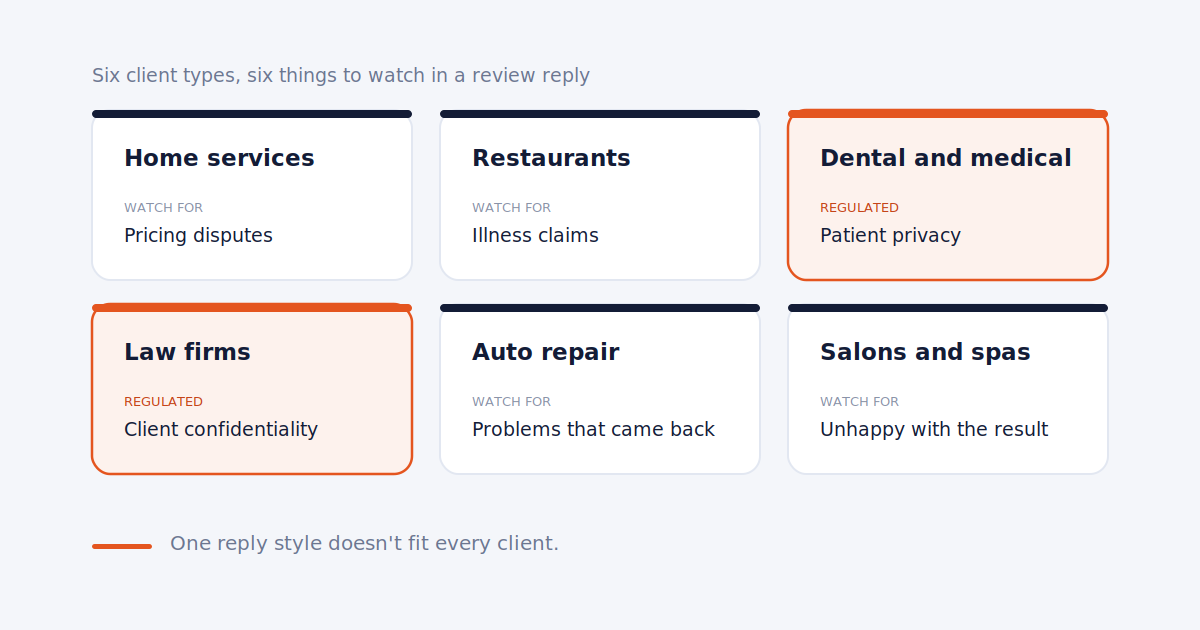
One caution on auto-replies: if you have dental or medical clients, don't let replies post without a human reading them first. We explained why in how to respond to Google reviews for dental practices.
What 10 client locations actually costs
If you need profile protection and rank tracking:
- Whitespark: Local Platform at $1 × 10 is $10, plus the agency rank tracker around $70. About $80 a month.
- Semrush Local Base: $30 × 10 is $300 a month, which includes a lot of automation you wouldn't use for this job.
If you need active posting and review replies on all ten:
- Semrush Local Base: $300 a month, and it does this out of the box.
- Whitespark: no posting or reply product, so you'd need a second tool for this anyway.
Two things to check on the Semrush side. Its pricing page lists Local as billed annually. And its help docs note that removing a location doesn't remove the paid location limit, so when a client leaves, your bill doesn't automatically drop. If your client list changes through the year, look at how that works before you sign up.
Check both vendors' current pricing pages before deciding. Whitespark's prices in particular vary between published comparisons.
Using both
Because they overlap so little, some consultants run both. Whitespark's Local Platform goes on every client as a cheap safety net, citation work gets bought as projects when a client needs it, and Semrush Local runs only on the clients paying for active content work.
That setup makes sense. Just add up the combined cost per client before you commit to it.
Who should pick which
Pick Whitespark if: citations are part of what you sell, you track a lot of keywords, you want low-cost protection on every client profile, or you'd rather pay once for project work than keep a subscription running.
Pick Semrush Local if: clients pay you to keep their profiles active, you want posting and review replies handled automatically, listing sync is part of your service, or you already work inside Semrush.
Where Surfa fits
Surfa overlaps more with Semrush Local than with Whitespark, but it's built around a consultant's week rather than a single business. AI-drafted review replies in each client's voice that you approve before they post, GBP posting across your whole roster, local rank tracking, and client-ready reports, all from one dashboard.
It doesn't build citations. If that's the job, Whitespark is the right tool.
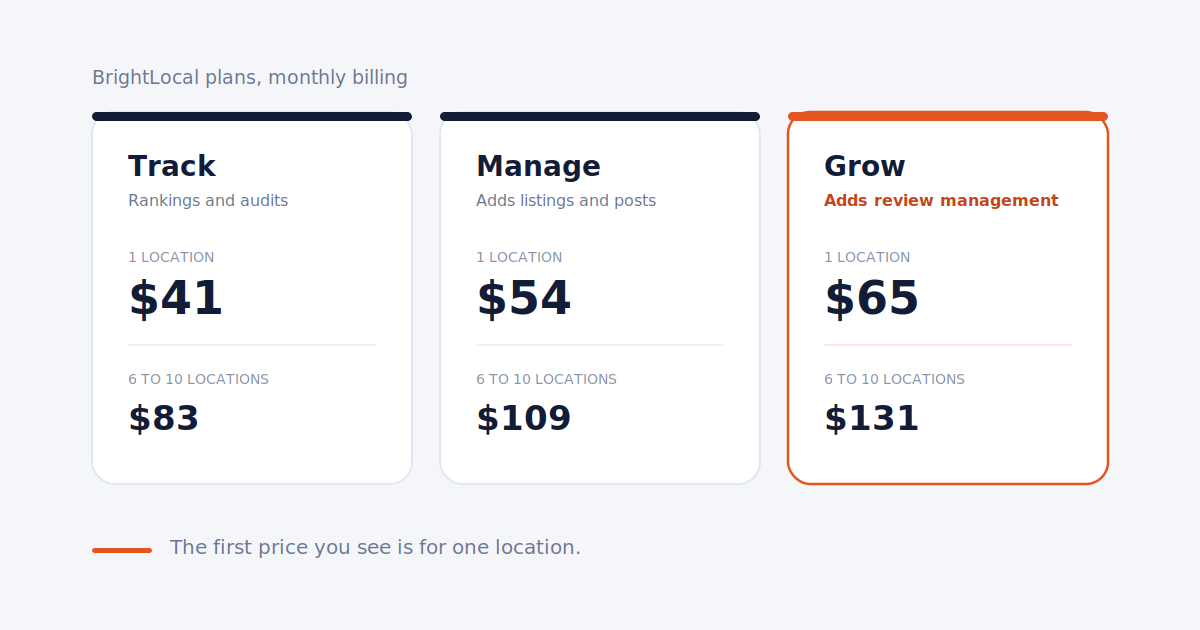
We've also compared each pair on its own: BrightLocal vs Whitespark, BrightLocal vs Semrush Local, and all three together in BrightLocal vs Whitespark vs Semrush Local.
Frequently asked
Is Whitespark or Semrush Local cheaper? For guarding profiles and tracking rankings, Whitespark, by a wide margin. For automated posting and review replies, Semrush Local, since Whitespark doesn't offer those.
Can Whitespark post to Google Business Profiles? Its Local Platform is built around change alerts, rejecting unwanted edits, change history, and bulk editing. Post scheduling isn't part of its listed features.
What happens to Semrush Local listings if I cancel? According to Semrush's help docs, the listings stay in the directories but are no longer managed, so they become subject to each directory's normal updates.
Do I need a Semrush subscription to use Semrush Local? No. It's sold as its own product with Base and Pro tiers.
Which is better for citations? Whitespark. Citation research and building is what it's known for.
The weekly work, in one place.
Surfa handles the recurring part of client GBP work: review replies, posts, rank tracking, and reports across every profile from one dashboard.
Start free trial