
Key highlights
- Lead with calls, directions, and website clicks, not rankings; show 5 to 10 keywords, not 50; include one thing you need from the client every month; say it in the first line when the month was bad
Most freelancers treat the monthly report as admin. Something you produce because you said you would, sent late on the last Friday of the month, built from whatever screenshots you can gather in an hour.
Meanwhile it's often the only thing the client actually sees. They don't watch you reply to reviews. They don't see the posts go up. The report is the product as far as they're concerned, and a bad one is one of the quieter reasons local SEO clients churn.
Here's a structure that takes less time to produce and does more work.
Start with one sentence
Put a plain-language summary at the top, before any numbers. One or two sentences.
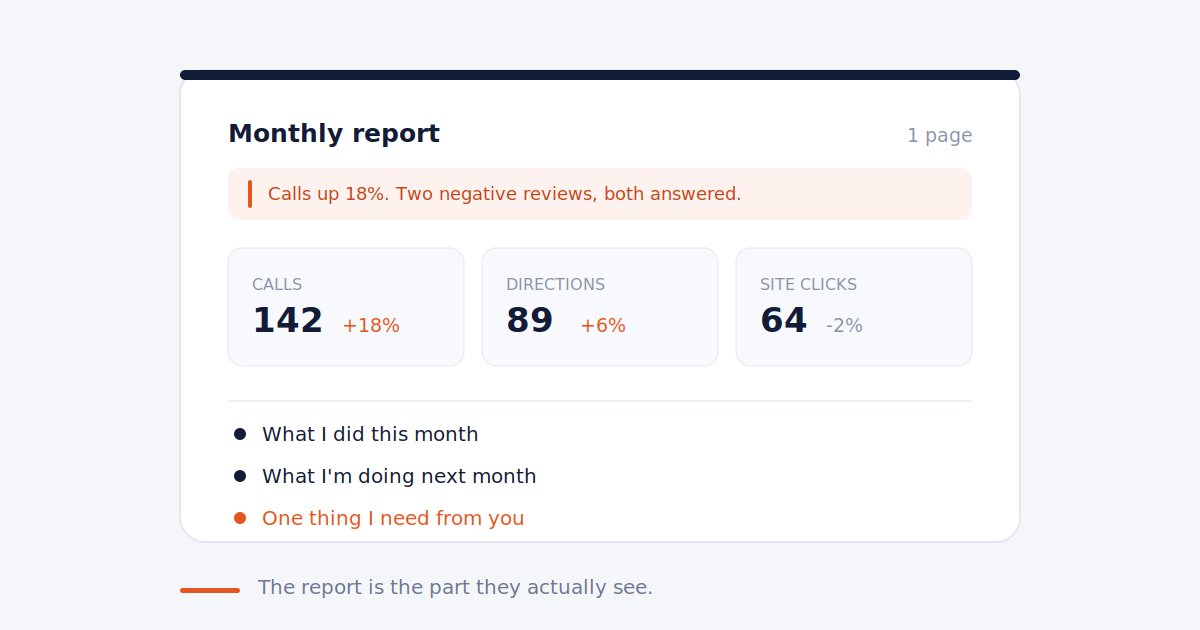
"Calls from your Google profile were up 18% this month, driven mostly by the emergency plumbing keywords. Two negative reviews came in and both are answered."
Write it last, after you've looked at everything. Most clients read this line and skim the rest, and that's fine. The rest exists so the line is defensible.
Lead with the business metrics, not rankings
The instinct is to open with rankings because that's what you work on. Resist it. Rankings are your input. The client cares about outcomes.
Three numbers from the GBP dashboard, with last month beside them:
- Calls from the profile
- Direction requests
- Website clicks from the profile
These are the closest thing you have to revenue on a local engagement. A client who can see calls trending up will forgive a lot.
If the business takes bookings rather than calls, swap in whatever the equivalent action is.
Then rankings, but fewer than you think
Five to ten keywords. Not fifty.
A fifty-keyword table looks thorough and communicates nothing. The client can't tell which rows matter, so they either ignore it or fixate on the one that dropped.
Pick the terms that actually drive the business, show current position and last month's, and write one line explaining any movement worth explaining. If you track by geo-grid, include one map image, not six.
Reviews
Three things:
- New reviews this month and the current average
- Your response rate, stated as a number
- Any review that needs the client's attention
That third item matters. Some negative reviews describe an operational problem you can't fix from the outside. Surfacing those is genuinely useful to the client and it positions you as someone thinking about their business, not just their profile.
What I did this month
A short list. Five to eight bullets, plain language, no jargon.
"Published 4 posts," not "executed content cadence per GBP optimization schedule."
This section exists because of a specific failure mode. Clients who can't see the work assume there wasn't any, and that assumption usually surfaces three months in as "what am I paying for again." A boring list of completed work prevents it.
What I'm doing next month
Three or four items. This is the section that does the most to keep a client, because it turns the report from a record into a plan. It tells them there's a reason to still be here in thirty days.
Keep it specific. "Adding services to the profile" beats "continued optimization."
One thing I need from you
Almost nobody includes this and it changes the relationship.
Every engagement has something blocked on the client. Photos they promised. Approval on a service description. A decision about whether to list a second location. Putting one clear ask at the bottom of every report does two things: it moves the work forward, and it quietly makes clear that outcomes depend partly on them.
Keep it to one item. A list of asks reads as complaining.
What to cut
Impressions and views as headline numbers. They move for reasons that have nothing to do with you, and a big number followed by a flat call count invites the obvious question.
Raw screenshots with no interpretation. A dashboard export is not a report. If you paste an image, write the sentence that says what it means.
Anything you can't explain. If a client asks why a metric moved and you don't know, that's worse than not including it.
Jargon. NAP, citations, geo-grid, SoLV. Your client does not know these words and will not ask.
Length and cadence
One page. Two if there's something genuinely worth explaining.
Monthly is right for most engagements. Weekly reports are a trap: local SEO doesn't move meaningfully in seven days, so you end up manufacturing news, and you've committed to producing 52 of these a year.
Send it in the first three business days of the month, every month, without being asked. Consistency matters more than polish. A plain report that always arrives on the second beats a beautiful one that arrives whenever.
When the month was bad
Say so in the first line.
Rankings slip. Google updates land. A competitor with a bigger budget shows up. Clients handle bad months better than you expect, as long as they hear it from you first and it comes with an explanation and a plan.
What they don't forgive is finding out themselves, or reading a report full of green arrows that contradicts what they're seeing in their own phone.
If you're consistently reporting bad months on the same account, that's a different conversation, and it's usually about scope or price rather than effort. We wrote about that in our guide on what to charge for GBP management.
The time problem
One report built this way takes 20 to 30 minutes if the data is in front of you. It takes an hour and a half if you're logging into separate dashboards, exporting, screenshotting, and remembering what you did three weeks ago.
At ten clients that's the difference between half a day and two full days, every month, on work that generates no new revenue. It's the most automatable thing in the whole engagement, because the structure never changes. Only the numbers do.
Frequently asked
How long should a local SEO report be? One page. Clients skim. A longer report doesn't get read more carefully, it gets read less.
Should I white-label my reports? If you're presenting as a solo consultant, your own simple template is fine and arguably better. White-labeling matters most when the client is an agency reselling your work.
What if the client never reads it? Most won't read it closely. Send it anyway. Its main job is to exist and arrive on time, so that when someone asks "what are we paying for," there are twelve of them in the inbox.
Monthly or quarterly? Monthly. Quarterly leaves too long a gap for a client to wonder whether anything is happening, and that gap is where cancellations form.
Reports that build themselves.
Surfa pulls every client's rankings, reviews, and profile activity into a report you can send in minutes instead of hours.
Start free trial