
Key highlights
- Market rates are a range, not a price - your delivery hours set your actual floor
- Minimum viable retainer = (hours per client × target rate) + tool cost + 20%
- Cutting per-client delivery time raises your revenue ceiling without repricing anyone
- Per-location tool pricing keeps software at a fixed % of revenue forever; flat-tier shrinks it
Search "Google Business Profile management pricing" and you'll get about forty results. Every single one is written for the business owner. What should you expect to pay. What's a fair rate. How to spot an overcharge.
Almost nothing is written for the person on the other side of that invoice.
So if you're a freelancer or a two-person agency trying to figure out what to charge for GBP management — and whether the number you landed on three clients ago still makes sense at fifteen — this is that guide. Market rates first, then the math that actually decides whether your pricing works.
What the market actually pays in 2026
Published pricing guides converge on roughly the same ranges. Use these as a sanity check, not a rule.
- GBP-only monthly management, single location: $125 – $475 / month
- Solo freelancer starter package: $300 – $600 / month per location
- Small agency package: $600 – $1,200 / month per location
- Broader local SEO retainer (GBP + citations + on-page): $500 – $1,500 / month
- One-time setup or profile overhaul: $300 – $750
- Hourly consulting: $75 – $150 / hour
Two things worth noticing.
The gap between the bottom and the top of each range is enormous — a 4x spread on the same nominal service. That spread isn't mostly about skill. It's about scope clarity, niche, and market competitiveness. A dentist in a metro market with eleven competitors in the map pack needs meaningfully more work than a septic contractor in a county with two.
And there's a real floor forming. Automated $99 packages exist, but they're a race you don't want to enter — the work that actually moves the map pack is the work that takes hours.
The number that decides your pricing isn't your rate
Here's the part the buyer-side guides skip entirely, because buyers don't care about it.
Your retainer is not really a price. It's a bet that you can deliver the scope in fewer hours than the retainer divided by the hourly rate you need. Everything else is decoration.
So before you set a number, audit what a single client actually costs you in a month. Not what you think. What it is.
- Review responses (5 reviews, written individually) — 20 min
- GBP posts (4 posts: write, source image, publish) — 45 min
- Rank checks (5 keywords, manually) — 15 min
- Photo uploads, hours, categories, profile hygiene — 10 min
- Monthly report — 25 min
- Client emails, questions, small requests — 20 min
That's roughly 2 hours 15 minutes before you account for anything else.
Then add the tax nobody puts on the invoice: logging into the right Google account, finding the credentials, waiting for a dashboard to load, remembering what you did for this client last month, and re-reading their brand voice notes before you write anything. Across a dozen clients, that context-switching realistically adds 20–30%.
Call it 2.75 to 3 hours per client per month.
At a $400 retainer, that's an effective rate of roughly $135 – $145 per hour. Which sounds fine. It is fine — right up until you look at what it does to your ceiling.
Your price floor, in one formula
Minimum viable retainer = (hours per client per month × your target hourly rate) + tool cost per client + 20% buffer
Run it at 2.75 hours, a $100 target rate, and $10 of tooling per client:
(2.75 × $100) + $10 + 20% = $342
That's your floor. Not your price — your floor. Anything below it and you're subsidising the client with your own time.
Now run the same formula at 1.25 hours per client, because you've consolidated the work into one place instead of six tabs:
(1.25 × $100) + $10 + 20% = $162
Same target rate. Same client. The floor dropped by more than half.
Why this is a capacity problem, not a pricing problem
This is the reframe that matters, and it's why "just raise your prices" is usually bad advice for a solo operator.
If you work 120 hours a month and delivery eats 3 hours per client, you top out at roughly 25 clients — and that's assuming zero hours for sales, onboarding, invoicing, or the client whose profile gets suspended in week two. Realistically the ceiling is closer to 15.
At 15 clients and $400, you're at $6,000/month and completely full. The only lever left is price, and price is the hardest lever to pull because it requires either churning clients or winning better ones.
Cut delivery to 1.25 hours per client and the same 120 hours supports far more clients — or the same 15 clients with 25 hours a month freed up for the work that actually grows the business.
Every minute you shave off per-client delivery raises your revenue ceiling without asking a single client to pay more. That's the lever. Pricing is downstream of it.
The line item that quietly scales with your client count
One more thing to build into your pricing before you quote: your tooling.
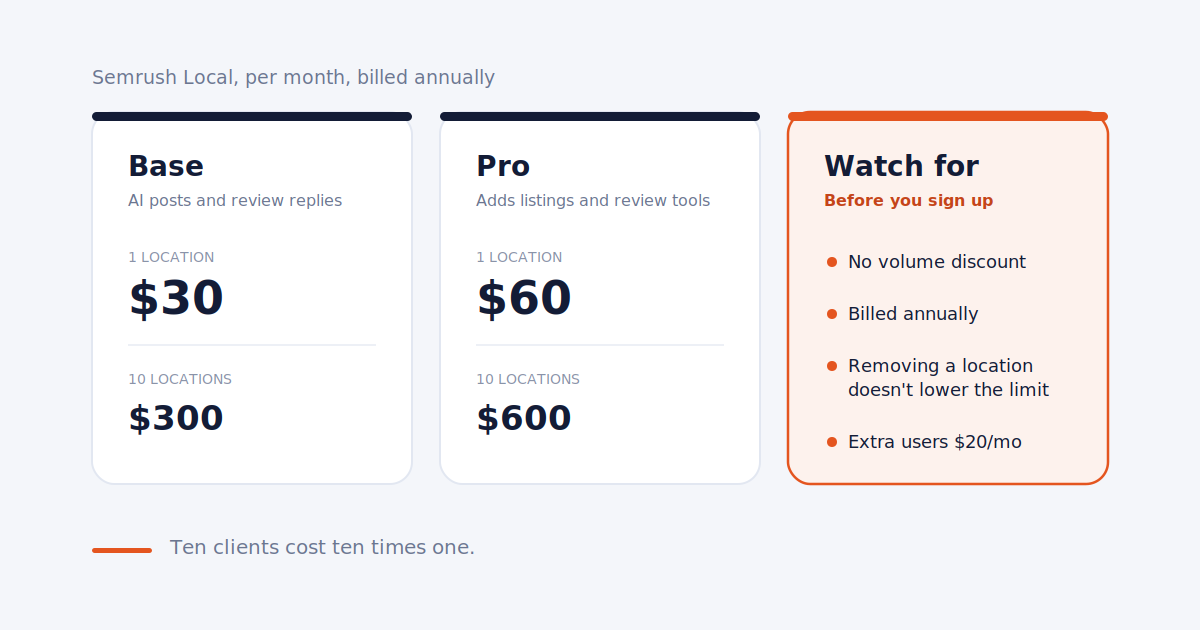
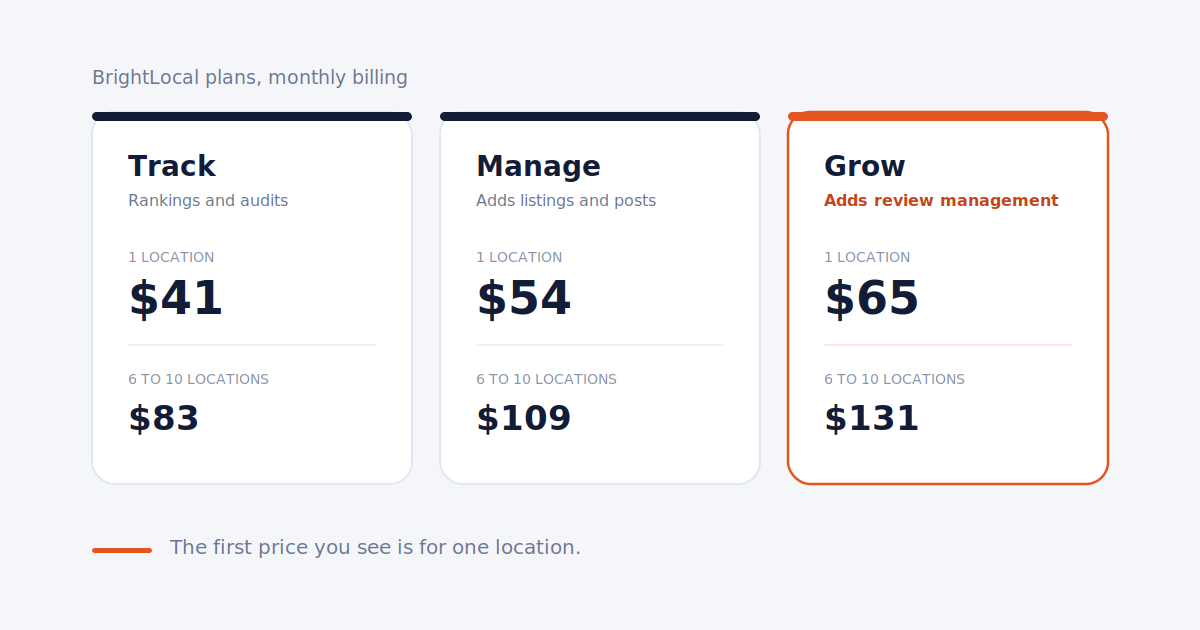
Most local SEO tools price per location. That model is fine at three clients and quietly punishing at fifteen, because your software cost grows in lockstep with your client count — it stays a permanent, fixed percentage of revenue no matter how big you get.
Flat-tier pricing behaves the opposite way. The cost is the same at 5 clients as at 20, so it shrinks as a share of revenue every time you add a client. That difference compounds into real margin over a year.
Whichever you use, do two things:
- Put the number in your floor calculation. Divide your total monthly tool spend by your client count and treat it as cost of delivery.
- Never itemise it on the client invoice. Bundle it. The moment a client sees a $29 line item, they start wondering why they're paying you $400.
Three package templates you can copy
Scope is what makes a price defensible. These are starting points — adjust to your market.
Essentials — $300–$450/month
Profile hygiene (hours, categories, services, attributes), review responses within 48 hours, 2 GBP posts per month, monthly one-page report. One location.
Growth — $600–$850/month
Everything in Essentials, plus 4 posts per month, rank tracking on 10 keywords, monthly photo uploads, Q&A seeding and monitoring, and a quarterly strategy call. One location.
Multi-Location — $1,200+/month
Everything in Growth for the primary location, plus $250–$400 per additional location, weekly posting cadence, review escalation workflow for anything under 3 stars, competitor tracking, and a monthly reporting call.
Setup fee — $300–$750, one time
Charge it. Initial optimisation, category research, duplicate suppression, and citation cleanup are real project work, and doing them for free inside month one is where most freelancers lose their first month's margin.
Five pricing mistakes that cost freelancers real money
Billing hourly for recurring work. You get punished for getting faster. Retainers reward efficiency; hourly billing taxes it.
Quoting before scoping the profile. A profile with 400 reviews and a history of suspensions is a different job than a clean one with 12 reviews. Do a five-minute look before you name a number.
No per-location multiplier. "We just added our second location" is not a free change order. Price it from day one so the conversation is already handled.
Absorbing tool costs invisibly. If you don't know your per-client software cost, you don't know your margin. You know your revenue.
Annual discounts without a floor. A 20% annual discount on a $300 retainer takes you to $240 — likely under your floor. Discount from a price that can survive it.
When to raise your price
Four signals, any one of which is enough:
- You're turning down work because you have no hours, not because the fit is wrong.
- Your close rate is above 70%. High close rates usually mean you're cheap, not persuasive.
- You've added scope over 18 months and never repriced. Almost everyone has.
- Your effective hourly rate on your three biggest clients has fallen below your target for two consecutive quarters.
The move isn't a blanket increase. Reprice new clients first, watch the close rate, then bring existing clients up at renewal with a scope refresh attached so it reads as an upgrade rather than an increase.
The short version
Market rates give you a range. Your delivery hours give you a floor. The gap between the two is your actual business.
Most freelancers try to fix a margin problem by raising prices, when the faster fix is reducing the hours a client consumes. Cut per-client delivery time and three things happen at once: your floor drops, your ceiling rises, and you can hold your price without flinching in a negotiation.
Audit your hours before your next proposal. The number will surprise you.
Frequently asked
$300-$600/month per location for a solo starter package, $600-$1,200 for agency-level scope. Below $300 you're usually under your delivery floor.
Yes. $300-$750 one-time. Initial optimisation, category research, and citation cleanup are project work.
Retainer. Hourly punishes you for getting faster at recurring work.
$250-$400 per additional location on top of the base retainer. Set it before the client asks.
Cut the hours, not the price.
Surfa puts every client's reviews, posts, rankings, and reports in one dashboard — so your per-client delivery time drops and your floor drops with it. Flat pricing, not per location.
Start free trial