
If you're a solo consultant managing 15 to 20 Google Business Profiles, review responses are quietly one of your biggest time leaks. Do the math: 15 clients, five reviews each per month that's 75 responses written from scratch. At three to five minutes per response, you've burned four to six hours before doing a single billable thing. Every month. AI response generator software is what fixes this, and this guide shows you exactly how to use it to protect your margins and your sanity.
The Problem Solo GBP Consultants Know Too Well
Writing a review response isn't hard. The problem is volume and context-switching and at 15 to 20 clients, both hit you at the same time.
You finish a response for a dental clinic, pivot to a landscaping company, then a restaurant, then a plumbing contractor. Each business has a different language, different customer concerns, a different tone you're trying to maintain in their voice not yours. You can't batch it or coast through it. Every response demands a full mental reset, and that cognitive overhead compounds faster than the actual writing time.
At 15 clients, review responses alone can consume 15–20 hours a month. At a modest $100/hour consulting rate, that's $1,500–$2,000 in labor you're either absorbing silently or failing to recoup because most solo consultants bundle review responses into the retainer rather than billing separately. It erodes your margins every single month without showing up on any invoice.
The deeper problem: every hour spent on review responses is an hour not spent on prospecting, strategy, or onboarding that 16th client. It's not just a time drain — it's a hard ceiling on how far your practice can grow.
What Surfa’s AI Response Generator Software Actually Does
AI response generator software reads each incoming review the star rating, the sentiment, the specific details the customer mentioned and generates a contextually appropriate response. It's not a template with blanks filled in. It produces a response that references what the customer actually said, in the right tone, aligned with that business's voice.
Purpose-built tools generate responses in seconds, queue them for your approval, and publish directly to the Google Business Profile. You're not cutting from a template library or manually prompting ChatGPT in a separate tab. You're reviewing output that's already 90% of the way there and approving it with one click.
The features that actually matter for a 15–20 client GBP workload:
-
Per-client voice customization — each business should sound like itself, not like a generic response template
-
Multi-client dashboard — all pending reviews across every client in one unified view
-
Review-and-approve workflow — a human checkpoint before anything goes live
-
Tone calibration for negative reviews — complaints require a different approach than five-star praise
-
Direct GBP publishing — no copy-paste, no tab-switching
Why not just use ChatGPT or templates? Templates get repetitive fast customers notice the same language cycling through, and Google's algorithms likely do too. ChatGPT can write a solid response, but you're managing prompts manually for every single review, across every client, with no dashboard, no approval queue, and no GBP integration. You've just traded one time sink for another. Purpose-built AI review response generators give you the intelligence of generative AI inside a workflow that's actually built for how you operate.
Why This Is the Highest-Leverage Tool for Solo Consultants at 15–20 Clients
The time math changes everything at this client volume. Here's what it looks like at 15 clients averaging five reviews per month:
-
Manual: 75 reviews × 5 minutes = 375 minutes (~6+ hours/month)
-
AI response generator: 75 reviews × 45 seconds review and approve = ~56 minutes/month
That's five-plus hours recovered every single month just from review responses. At 20 clients, you're pushing toward seven hours monthly. That's nearly a full billable day handed back to you.
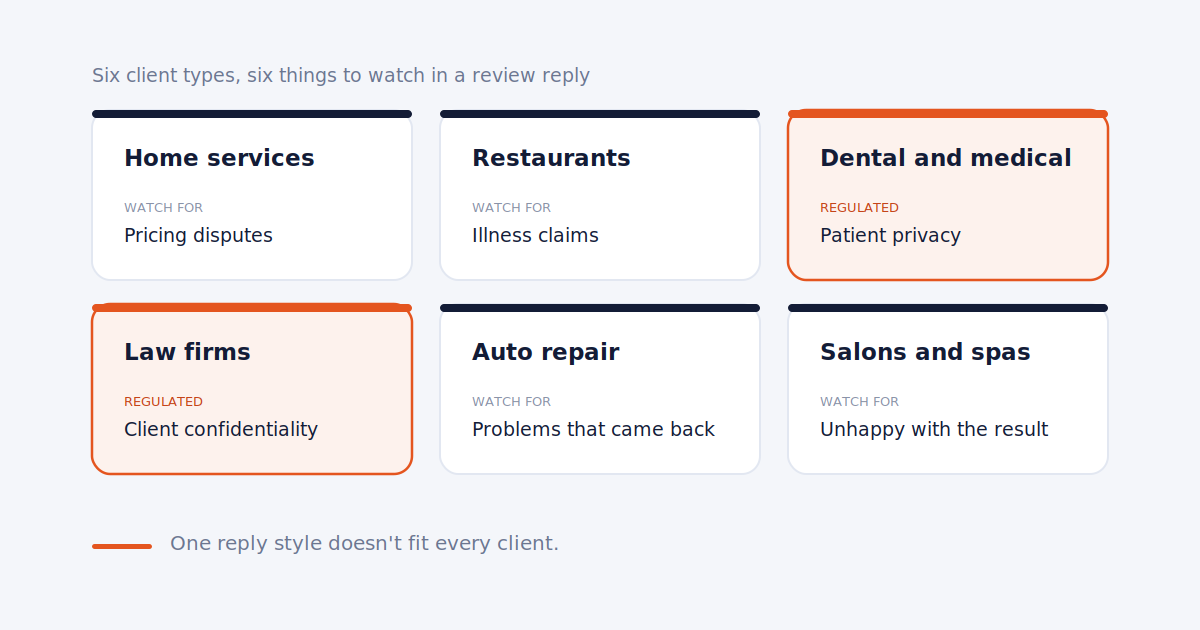
Brand consistency across 15–20 clients is where solo consultants quietly lose quality. A dental practice, a bar, a law firm, a landscaping company — they cannot sound alike. Manually holding all of that context in your head while producing 75 responses a month is where voice drift happens: responses start sounding like you instead of the business, or worse, they all start sounding the same. AI response software lets you configure voice settings per client once — tone, terminology, phrases to use or avoid, how the business refers to its customers. After setup, every response reflects the right voice without you thinking about it.
The 15-to-20 client range is specifically where automation becomes non-negotiable. Below ten clients, manual management is tight but survivable. Above 20, you typically need to hire. But in that 15–20 range, you're carrying a full operational load solo — and review responses are usually the biggest recurring time block that doesn't require your actual expertise. That's exactly what should be automated first.
Faster responses also protect and grow client results. Businesses that respond to reviews consistently and promptly tend to perform better in local pack rankings over time. And clients notice: when a business owner sees their reviews answered within hours instead of days or weeks, it's visible proof that their GBP is being actively managed. At 15–20 clients, that kind of consistent execution is what keeps retainers renewing.
How It Fits Into Your Daily Workflow
The workflow is simple by design — because adding steps defeats the point of automation.
A new review comes in. The AI generates a response based on the review content, star rating, and that client's voice settings. You open your dashboard, scan the queue across all clients, and approve or make a quick edit. The response publishes directly to GBP. Total time: 30 to 60 seconds per review. Most solo consultants batch this once a day — five to ten minutes to clear the full queue across all 15 to 20 clients.
Review response data doesn't stay siloed either. Patterns in what customers are praising or complaining about feed into your strategic recommendations for each client. If one client keeps getting dinged for wait times, that's not just a review to respond to it's an optimization signal worth flagging in your monthly report. And that report builds itself: response rate, response time, and review volume trends are captured automatically, without you manually assembling a deck.
The Margin Math for a Solo Practice
| Approach | Monthly Cost | Consistency | Scalability | Setup |
|---|---|---|---|---|
| Manual | $0 (but 6+ hrs/month) | Variable | Hits a wall at ~12 clients | None |
| Hire a VA | $500–$1,500 | Moderate | Limited by their capacity | Weeks |
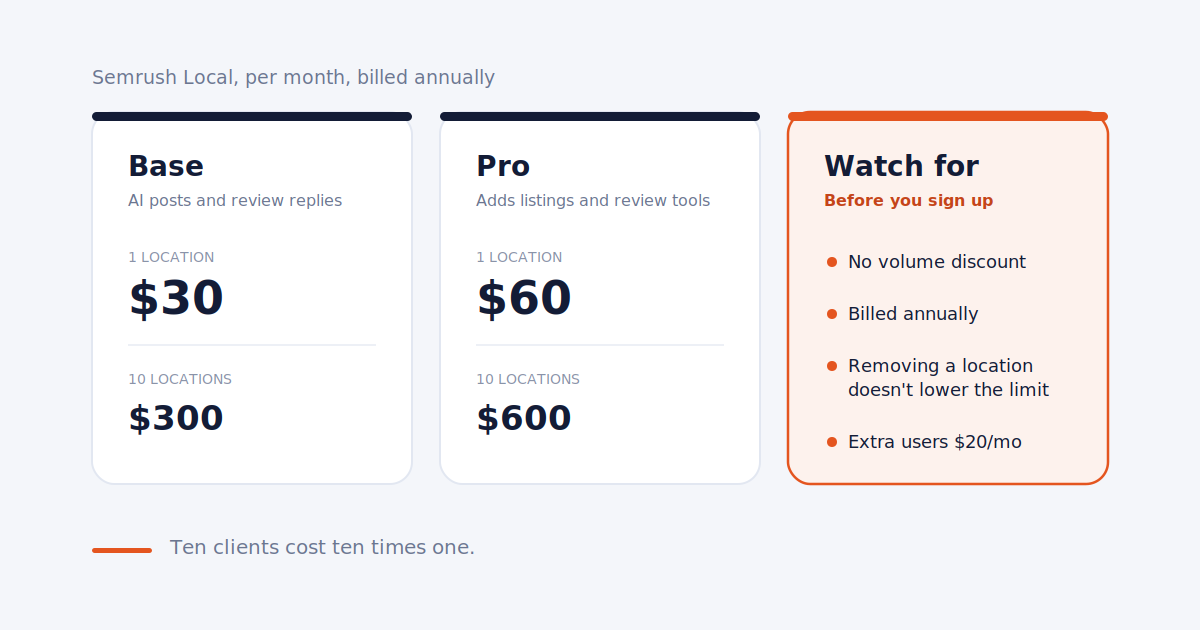
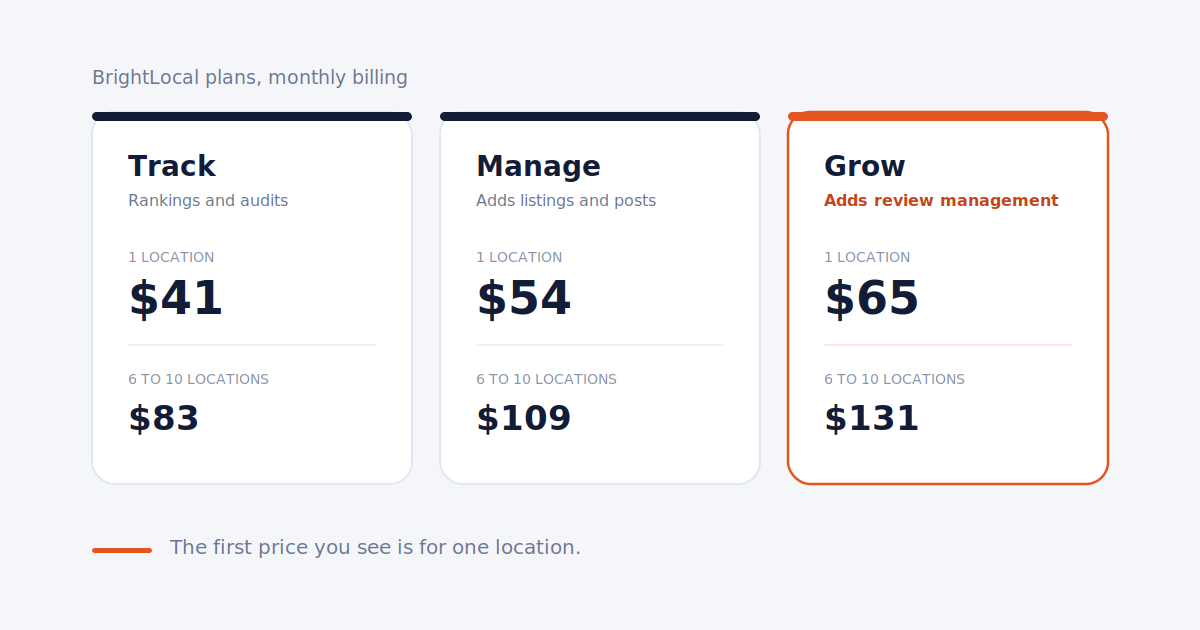
| AI response generator | ~$99/month | High | Handles 20+ clients easily | 1–2 hours |
At a $100/hour rate, recovering six hours monthly is $600 in recaptured time value — against a ~$99/month tool cost. Net gain: $500+ before factoring in the additional client you can now take on. Add one new client at a $500/month retainer and the tool pays for itself in week one, with five hours of your month still saved.
For small agencies managing GBPs across a team, the math is even sharper — the approval workflow can be distributed across team members while the AI output stays consistent.
Getting the Most Out of AI Response Software
Configure voice settings before enabling responses for any client. Spend ten minutes per client upfront: note the tone (formal, warm, casual), any industry-specific language, phrases to avoid, and how the business refers to its customers — guests, patients, clients, customers. The better the configuration, the less editing you'll do at approval time.
Know what to auto-approve and what to read carefully. Standard positive reviews with general feedback typically clear with minimal review. Be more hands-on with responses that mention a specific staff member by name (verify the AI captured it correctly), describe a unique situation or service, or involve a negative review where tone really matters. The AI gives you a strong draft — but take 30 seconds on anything sensitive before it goes live.
Take negative reviews seriously at the approval stage. Good software detects low star ratings and shifts tone automatically — more empathetic, less defensive, oriented toward moving the conversation offline. Your job at approval is to verify that the specific complaint is acknowledged accurately and that nothing in the response could escalate the situation. A well-handled negative response protects the client's reputation with every future customer who reads it.
Treat review content as strategic input. When you're scanning your approval queue daily, you're also reading what customers are actually saying about each business. Recurring complaints, unexpected praise, specific service mentions — these are insights that should feed into your optimization recommendations and monthly reporting. Review responses aren't just reputation management. At 15 to 20 clients, they're one of your richest ongoing sources of client intelligence.
Frequently asked
Not if properly configured. With brand voice, industry context, and review details, AI creates natural, personalized responses.
Yes. Each client can have a unique brand voice, ensuring responses match their business and industry.
Yes. Setup takes about an hour, and daily review management only requires a few clicks.
Absolutely. It helps small teams save time while keeping responses consistent across clients.
Templates are repetitive. AI generates unique, context-aware responses for every review.
Yes. Saving just a few hours each month often covers the cost, making it a valuable investment.
Take Back Control of Your Client Reviews
Solo GBP consultants managing 15 to 20 clients don't have a skill problem — they have a capacity problem. Review responses are high-volume, predictable, and don't require your strategic judgment to execute well. That's exactly what should be automated. The break-even on AI response generator software is measured in days. Recover five to six hours a month, take on one more client, and the tool has paid for itself before the first billing cycle closes. The consultants running lean, profitable practices at 15–20 clients aren't grinding harder. They've systematized the right things first — and review responses are always where that starts.
Start Your Free Trial