
Key highlights
- Ask for Manager, not Owner, it covers all the work you were hired for; Request Access gives the current owner three days to respond; new owners face a seven-day limitation window; ask who owns the profile during the audit, before you quote
You've done the audit, sent the quote, and the client said yes. Then onboarding stalls for eight days because nobody can figure out who owns the Google Business Profile.
This happens on a large share of engagements, and it's avoidable if you know the timelines going in. Here's the process for each situation you'll actually run into.
First, decide what access you need
Google has three roles: Primary Owner, Owner, and Manager.
Most freelancers ask for Owner when Manager is enough. Manager lets you edit business info, publish posts, respond to reviews, upload photos, and see performance data. That covers essentially all of the work you were hired to do.
What Manager cannot do is add or remove other users, delete the profile, or transfer ownership. Which is fine. You probably don't want that responsibility on a client's asset anyway.
Ask for Manager unless there's a specific reason you need more. It's an easier ask, and clients are noticeably more comfortable granting it.
Scenario one: the client has access and cooperates
This is the five-minute version. Send them these steps:
- Search their business name while signed in to the Google account that owns the profile
- Open the business profile panel and find "People and access" or "Business Profile settings"
- Click Add, enter your email, choose Manager, and send
You'll get an email invitation. Accept it. Done.
Two things that cause friction here. Make sure they're signed into the right Google account, because most people have several and the profile is often on one they never use. And send them your email address in the message so they don't have to ask.
Scenario two: nobody knows who has access
Extremely common. The profile was claimed years ago by a former employee, a web developer, or an agency the client has lost touch with.
The path is the Request Access flow. Find the business on Google Maps, click "Claim this business" or "Request access," and submit.
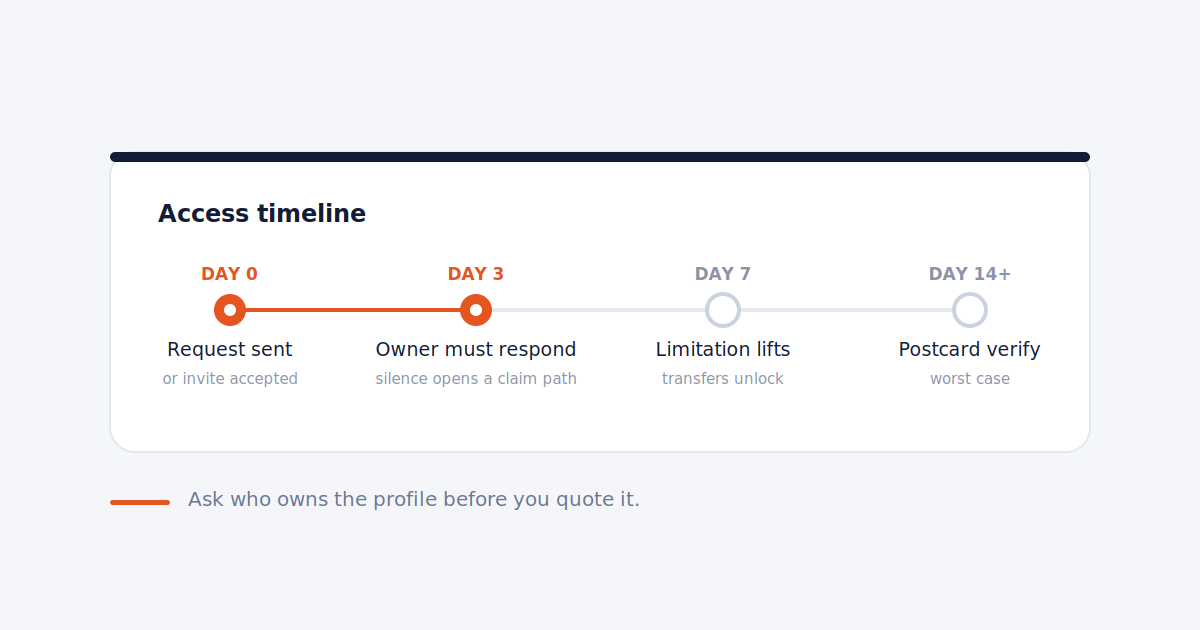
The current owner gets three days to respond. If they approve, you're in. If they decline, you can appeal or suggest an edit. If they don't respond at all, Google may offer you a path to claim the profile, which usually means verification.
Verification timing varies by method. Video verification is often resolved in about 48 hours. Postcard verification can take one to two weeks.
So the realistic range here is three days if someone responds quickly, and two to three weeks if it goes to postcard verification. Build that into what you tell the client.
Scenario three: the previous agency holds it and won't let go
Less common than people fear, but it happens.
Start by having the client ask directly. An email from the business owner to the agency asking for access transfer resolves most of these, because refusing is a bad look and the agency usually has no interest in maintaining a profile they're not being paid for.
If that fails, the client can use Request Access, and Google will weigh the claim. The business owner requesting access to their own profile is a stronger position than yours.
What you should not do is create a second listing to get around it. A duplicate splits your signals, and resolving it later is harder than waiting out the original problem.
The seven-day rule that surprises everyone
If ownership is actually being transferred rather than just access granted, Google applies a seven-day limitation window to new owners and managers.
During those seven days, the new user cannot remove other users, delete or restore the profile, or transfer primary ownership to anyone. This is a security measure aimed at profile hijacking, and it is not negotiable.
Practically: a full ownership transfer takes about seven to ten days from start to finish. The invitation gets accepted in minutes, then everyone waits.
This matters most on business sales and agency handoffs, where people plan a same-day transfer and then discover they can't complete it. If you're inheriting a profile as part of a larger transition, tell the client the timeline before it becomes a problem.
Four things not to do
Don't ask for the client's password. It violates Google's terms, it destroys the audit trail of who changed what, and if anything goes wrong you have no way to demonstrate it wasn't you. Roles exist for this reason.
Don't change the business name, address, or phone during a transfer. Sensitive edits during an access change can trigger a review or a suspension. Get access first, let it settle, then make changes.
Don't remove the old owner immediately. Confirm your access works by actually editing something before anyone gets removed. If the transfer didn't fully take, you'll want the previous owner still reachable.
Don't panic at errors in the first week. A permission error inside the seven-day window is usually the limitation period, not a failed transfer.
Put this in your onboarding
The reason access turns into a problem is that most freelancers raise it after the contract is signed, which is when the clock starts on a process that can take two weeks.
Move it earlier. During the audit, when you're already looking at the profile, ask two questions: who currently owns this, and can you log in right now to show me. The answers determine whether onboarding is a five-minute step or a three-week one, and knowing that before you quote lets you price it honestly. We covered the rest of that pre-quote check in our GBP audit checklist.
Then in your onboarding email, include the exact click path for granting Manager access and your email address. Removing the need for the client to figure it out removes most of the delay.
Frequently asked
Manager or Owner, which should I ask for? Manager. It covers posting, reviews, photos, business info, and performance data. Owner adds user management and deletion rights you probably don't want on a client's asset.
How long does Request Access take? The current owner has three days to respond. No response can open a claim path, which then depends on verification. Video verification is often about 48 hours, postcard can take one to two weeks.
Can a Manager transfer ownership? No. Only the Primary Owner can transfer primary ownership, and the recipient has to be an Owner who has cleared the seven-day window.
What if the client has two profiles for the same business? Get access to both before doing anything. Resolving duplicates is a separate job with its own timeline, and it belongs in your setup fee rather than your monthly retainer.
Do I need a Gmail address? No. Any Google account works, including a Google Workspace address on your own domain.
Access sorted. Now the actual work.
Once you're in, Surfa handles the recurring part across every client profile: reviews, posts, rank tracking, and reports from one dashboard.
Start free trial